The Commodification Paradox
When Contemporary Art and Beauty Share the Same Economic Logic
Editor’s Note
Art critiques desire. Beauty engineers it.
Today, both move through the same system.
This issue explores the growing collapse between contemporary art and luxury beauty — not aesthetically, but structurally. What happens when scarcity, cultural capital and speculation begin to shape both creative expression and cosmetic objects in similar ways?
— Nassim
I. The Philosophical Tension
For much of modern history, contemporary art positioned itself as a space of resistance. It stood, at least conceptually, outside commerce — a place designed to question value rather than participate in it. Artists challenged institutions, disrupted aesthetics, and exposed the mechanics of consumer culture. The artwork was meant to create distance, inviting reflection rather than consumption.
Yet this separation has never been entirely stable.
Today, artists such as Jeff Koons, Damien Hirst, Yayoi Kusama and KAWS operate inside a global ecosystem driven by scarcity, institutional validation and market speculation. Their works circulate through auctions and private collections with dynamics closer to financial assets than traditional artistic objects. Contemporary art critiques capitalism while simultaneously thriving within its structures.
Beauty, by contrast, never attempted to stand apart from the market. Cosmetics are inherently commercial. They exist to be produced, sold, applied and replaced. For decades, this commercial clarity excluded beauty from intellectual discourse, positioning it as decorative rather than conceptual.
That distinction has quietly collapsed.
II. Capitalism as Shared Infrastructure
What now links contemporary art and luxury beauty is not merely aesthetics but economic architecture.
Scarcity has become central to both worlds. Limited editions, controlled launches and collectible objects shape perception and value. The drop model — once associated with artist multiples or street culture — now defines luxury beauty releases. Products are designed not only for use but for display and cultural signalling.
Artists like Takashi Murakami anticipated this convergence by moving fluidly between gallery environments and commercial collaborations, showing that cultural and commercial value could coexist rather than compete. Beauty brands increasingly adopt similar logic, approaching launches as cultural moments rather than purely transactional events.
Capitalism here is not a background condition but a shared language. Narrative, access and visibility determine value as much as materiality or performance. The paradox becomes clear: art critiques the market while depending on it; beauty embraces the market while seeking cultural legitimacy.
III. The Artist as Brand, the Brand as Curator
A parallel transformation has unfolded in how creative authority is constructed.
The contemporary artist increasingly operates as a brand — maintaining coherence, identity and strategic visibility. At the same time, brands behave more like curators, constructing aesthetic worlds rather than simply selling products.
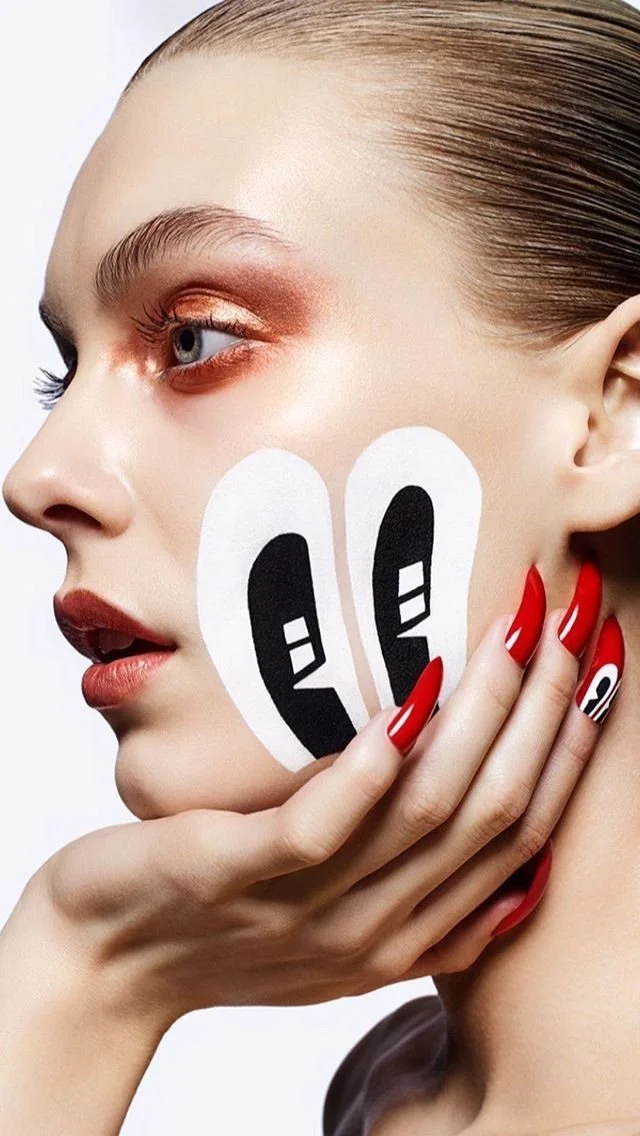
When Pat McGrath created porcelain-like skin for Maison Margiela, the result felt closer to performance than traditional beauty. The face became medium; the runway became exhibition space.
Beauty is no longer merely enhancement. It is narrative — capable of carrying conceptual weight while remaining unapologetically commercial.
IV. The Digital Collapse
Digital culture has accelerated the convergence between art and beauty by flattening the spaces that once separated them. Paintings, installations and makeup editorials now circulate through the same feeds, competing for attention within identical systems of engagement.
Algorithms do not distinguish between critique and commerce — they measure visibility.
Series such as Euphoria shifted makeup from correction toward emotional storytelling. The face became a participatory canvas, accessible to millions rather than confined to institutional contexts.
Beauty may now be the most democratic form of contemporary art — immediate, embodied and reproducible. Yet democratization intensifies commodification rather than dissolving it. As participation expands, scarcity regains importance as a marker of differentiation.
V. Looking Forward
The next evolution may move beyond physical objects altogether. As digital identity, AI-generated visuals and hybrid physical–virtual experiences reshape culture, value will increasingly reside in narrative systems rather than singular products or artworks.
The collectible of the future may not be a painting or a cosmetic object, but a visual language — something capable of moving across platforms, identities and contexts. Artists and brands alike will compete not only to create products, but to author meaning.
In that landscape, beauty may emerge as one of the most agile cultural mediums — faster, more participatory and more responsive than traditional artistic institutions.
VI. Living Inside the Paradox
The commodification paradox is not a contradiction to be solved. It is the condition of contemporary culture. Art critiques capitalism while thriving within it; beauty thrives within capitalism while seeking cultural depth. Both now operate through the same architecture of desire.
To create today — whether on canvas or on skin — is to engage with this system consciously. The question is no longer how to stand outside it, but how to shape it with intention.
Beauty. Curated like fashion.